
Trace Upson County's Former Owners
A deed-chain-backward table keeps every transfer tied to the instrument that supports it. Begin with the newest deed. Add one row per matched transfer. Never guess at unknown dates or deed types; the core columns are transfer date, grantor to grantee, instrument type, and book/page.
| Transfer Date | Grantor to Grantee | Deed Type | Book/Page |
|---|---|---|---|
| Newest recorded date | Prior owner to current grantee | Read from instrument | Copy exact reference |
| Next earlier date | Earlier owner to prior owner | Read from instrument | Copy exact reference |
| Continue backward | Repeat with each matched grantee | Note any probate or other transfer | Preserve each source trail |
The table is a working timeline. It is not a title opinion. Each row must match the same property through its legal description, plat reference, parcel clue, or adjoining-owner calls. Names alone can join unrelated people. Prior owners become reliable only when each name links to the same tract. Search each prior owner as a grantee. Then test that acquisition deed against the next step back. This discipline turns scattered former owners into an ordered chain. It also keeps similar names from merging.
Bridge Upson's Two Index Windows
The Upson Clerk has announced a useful resource. Grantor and grantee index books from 1938 through 1989 were imaged and made searchable, with matching deed-book images through GSCCCA. The statewide GSCCCA Real Estate Index describes all-county transactions beginning January 1, 1999 and says historical data is still being added. Those statements are not one continuous guarantee.
Use the Upson-linked Kofile search for the local run. Use GSCCCA for the later statewide system. Ask the Clerk about the years between the stated windows. A blank web result may mark a portal boundary, a spelling issue, or an indexing gap rather than a break in ownership.
Known online depth. Upson's specific imaged grantor/grantee window is 1938 through 1989. Earlier owners and uncovered years may require books, microfilm, or clerk help.
See Upson's Deed Search Hub
The official Georgia real-estate index hub lists its search routes plainly. Users can choose name, book/page, property, lien, plat, PT-61, and UCC lookups from one place.
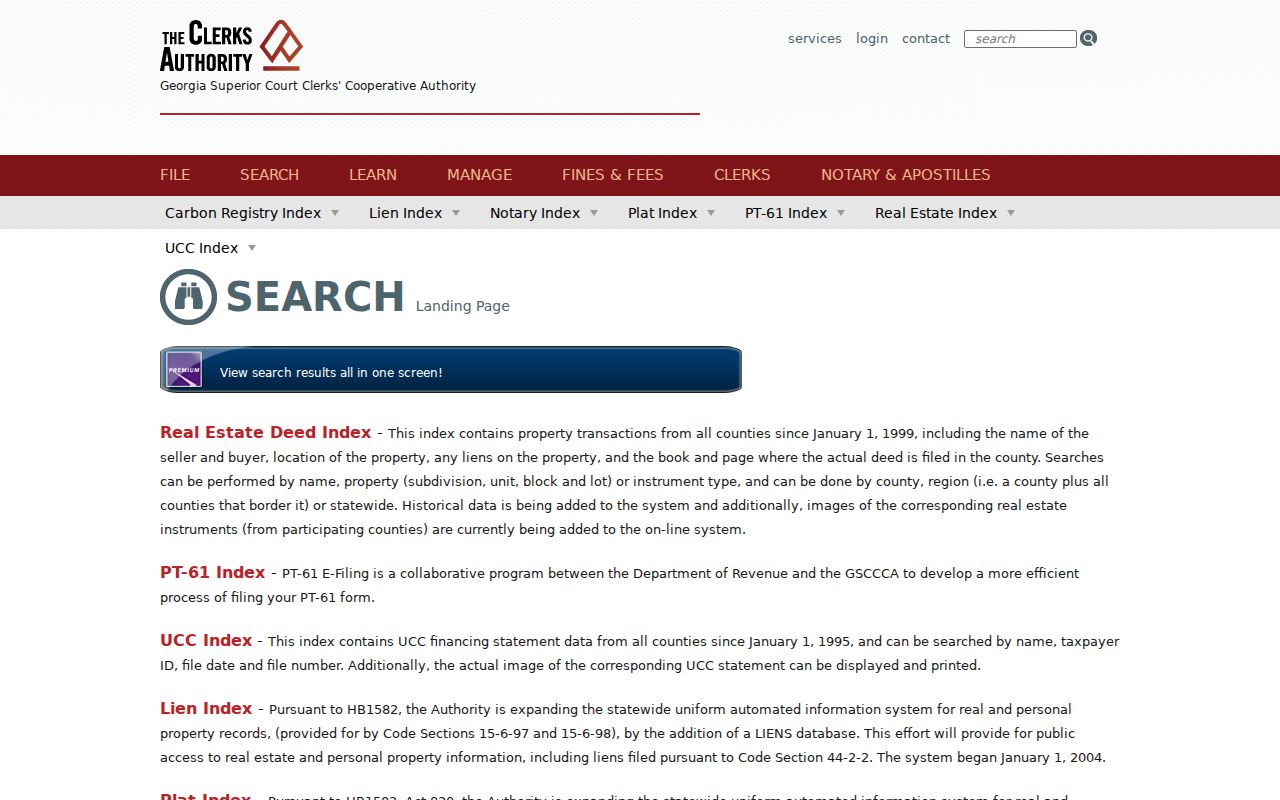
The hub shows where to continue the deed chain. A menu hit or index line is not the full instrument, so open the deed image or request the record from the clerk.
Reconstruct Upson's Deed Chain
Read the chain in reverse. The current owner's acquisition deed names the prior transferor. That grantor then becomes the grantee to search in an earlier deed. Keep the property description beside every name so a same-name record does not pull the chain onto another tract.
- Find the current title deed with today's owner shown as grantee.
- Record the grantor, date, deed type, book/page, and complete land description.
- Search that grantor as an earlier grantee and match the same land.
- Repeat until the online index ends, then continue through books, microfilm, plats, or archives.
- Grantor
- The party transferring the interest described by the deed.
- Grantee
- The party receiving that stated interest.
- Chain of title
- The linked sequence of instruments affecting ownership of the same land.
- Reverse index
- An index organized to help find instruments by the receiving party.
- Quitclaim and warranty deeds
- Different deed forms whose precise effect must be read from the instrument.
Follow Upson's Land Description
A street address can change. The land description is the better thread. A modern subdivision deed may cite lot, block, subdivision, and plat book, while rural Upson land may use metes and bounds, district and land lot, survey calls, road frontage, or adjoining owners. Copy each phrase before you go back a generation.
Recorded plats through the Clerk and GSCCCA can bridge a renamed road or split tract. The statewide Plat Index became operational for county submissions in 2004. Older maps may remain in local books or archives. A plat depicts the recorded layout, but it does not replace a current boundary survey.
Repair Upson Probate Breaks
Chains often stop at a death. Search the Upson Probate Court estate route for wills, administration, executor or administrator authority, petitions, orders, inventories, and returns. Then check the deed index again. Look for an executor deed, administrator deed, assent, survivorship instrument, or later transfer.
Probate records can explain why names changed. A death certificate or estate docket is not itself a deed. Match every estate clue to the land. When a recorded instrument carried the transfer, tie the name to that deed.
Extend Upson Owners Before 1938
The Thomaston-Upson Archives reports local government records as early as 1821, including tax digests, court dockets, and minute books. The county microfilm inventory names Superior Court and Surveyor General material, census schedules, church records, and long newspaper runs beginning in the 1830s.
A tax digest can place a name with land in a year when a deed index is hard to use. Newspapers may carry estate sales, sheriff's sales, subdivision notices, and road changes. These sources bridge a gap. They do not replace the deed. Record each citation. Return to the clerk's books to confirm the transfer.
Note: Upson archive evidence can bridge a missing index hit, but the recorded land instrument remains the core chain source.
Measure Upson Ownership Depth
Upson County owners can reach deep. No online run covers every year before the web portals. The archive's early date describes its holdings as a whole, not a promise that every parcel has a deed back to that year. Ask the Clerk what comes next. The right deed book, index, reel, or plat should follow the last confirmed citation.
Read the whole record. An index hit is a locator, not the deed. Former-owner work must follow the image, legal description, and later releases or corrective instruments.
No documented courthouse-fire loss marks Upson's records. The severe fire involved the R.E. Lee Institute building, not proven destruction of courthouse books. Do not invent a records gap. Anchor the present with the current Upson owner record, trace backward from verified evidence, and keep careful notes.